Student Life & Culture
Fulcrum’s Montessori prepared environment and civilizational curriculum come alive in our unique student life and culture. Fulcrum’s campus life reinforces our principles through real-world responsibility and joyful engagement with all the opportunities life affords.
Campus life
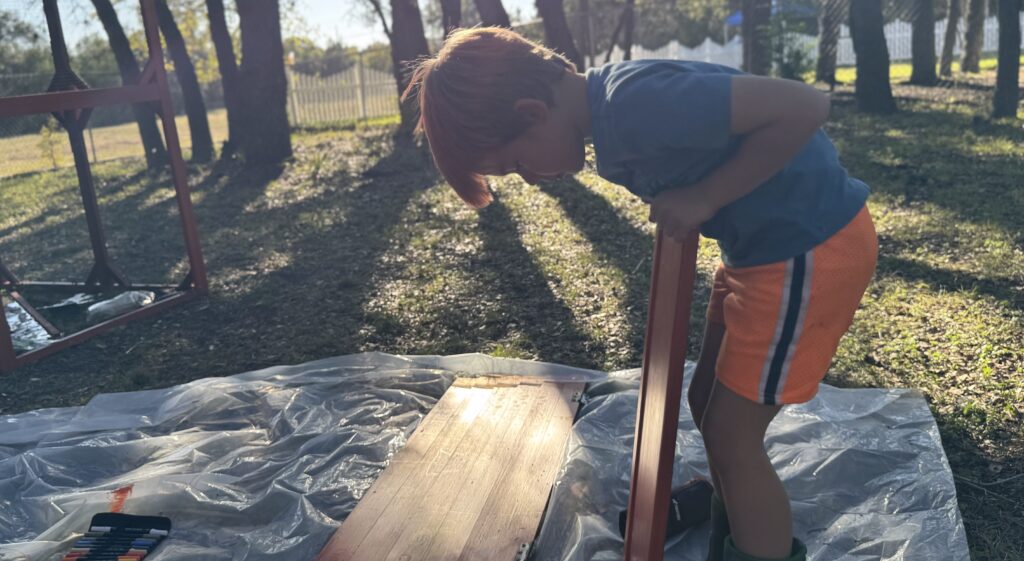
Our beautiful natural environment includes a woodshop, barn, and gardens. Students care for animals and the environment. We have chickens on site, hatched from eggs and cared for by our students. This is only the beginning.
Field trips & guest lessons
Our frequent field trips are an integral part of our curriculum. Significant travel may be included when valuable. This year, for instance, we have traveled to Houston to explore Medieval and Renaissance Art at the Museum of Fine Arts. We will soon travel to Utah to view an authentic Gutenberg printing press. To enhance our studies of the Renaissance, students and their families will spend a week in Florence, Italy.
We host guest lessons from world experts in their fields. For instance, a philosophy professor has joined us to teach about Plato and Aristotle. Musicians have brought historical instruments to campus to perform period music live for our students.

Music and art
Mastery, discipline, and aesthetic joy. Students put on plays and poetry recitals. They take art classes, create digital animations, and discover themselves through working with their hands. Our upcoming workshop will introduce more crafts, and allow them to build with real tools.
Standardized tests
While we do not place primary emphasis on tests, we do have our students take a battery of standardized tests over the course of the year. This is in part as a data point for staff and parents, and in part to ensure that students have mastery over practical test-taking skills.
Homework
Homework in individualized based on the overall context of child and family life. Homework must be a focused, purposeful extension of meaningful work—never busywork.
Community ethos
The ethos of our community consists of honesty, kindness, and respect for reality and reason. Students see their school as a second home and treat it accordingly. Each student has responsibilities as a community member to contribute to the functioning of the whole.